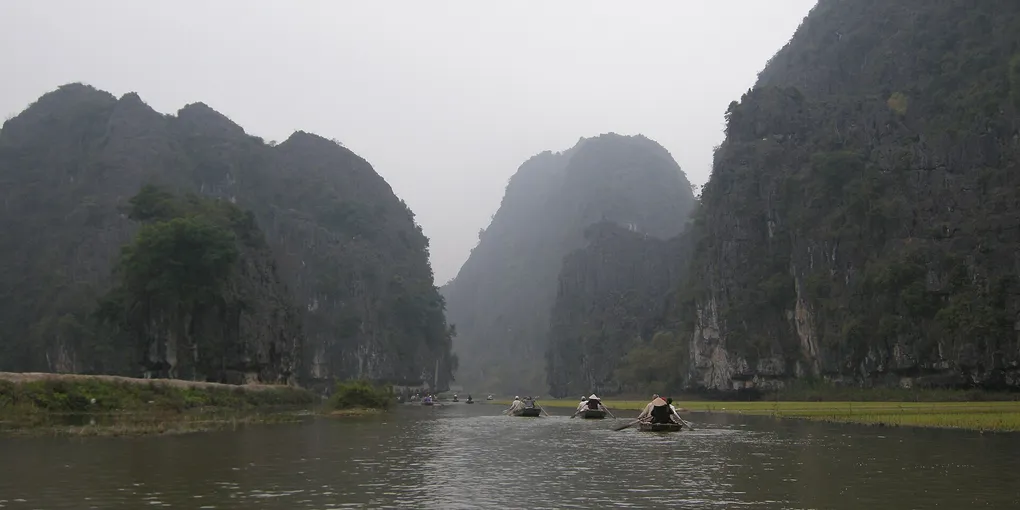
Two hours south of Hà Nội by road or train, Ninh Bình is what you get when you drain Hạ Long Bay and plant rice in it: limestone towers rising out of green paddies, rivers threading between and underneath them. It is my standard answer to “I have one free weekend in the north — where do I go?”
Getting there
You have three good options. The train from Hà Nội station is the scenic, unhurried choice — about two and a half hours to Ninh Bình station, and the southbound line out of the city is a pleasant ride in itself. Limousine vans (the nine-seater kind that hotels can book for you) are the practical choice: door to door in around two hours, comfortable, and cheap enough that two people should not bother with anything else. Ordinary intercity buses from Giáp Bát station are the budget fallback. However you arrive, rent a motorbike or bicycle locally, or negotiate a taxi for the day — the sights are spread across fifteen kilometres or so of countryside, and the riding between them is half the pleasure.
Day one: the river and the view
Start with a boat. The two classic options are Tràng An and Tam Cốc, and the choice is a matter of taste. Tràng An, a UNESCO World Heritage landscape, offers longer routes through a chain of caves and temple stops, and is the better-organised experience. Tam Cốc is shorter and more famous for the ripening rice season (late May–early June), when the valley turns gold — but it is also more heavily touristed. Either way, you will spend two to three hours being rowed through caves low enough that you duck — and in Tam Cốc, likely by a rower steering the oars with their feet, a local speciality that never stops being impressive.
In the late afternoon, climb the ~500 steps up Hang Múa for the postcard view: the river below, karsts to the horizon, and just enough burn in your legs to justify dinner. Speaking of which: Ninh Bình’s local specialities are dê núi (mountain goat, usually eaten with fresh herbs and rice-paper wraps) and cơm cháy (crispy rice). Order both.
Day two: the old capital
Before Thăng Long, there was Hoa Lư — the fortified valley that served as Việt Nam’s capital in the 10th century under the Đinh and Early Lê dynasties. The surviving temples to kings Đinh Tiên Hoàng and Lê Đại Hành are modest, but standing in the valley makes it obvious why a 10th-century ruler would put his capital here: the mountains are the city walls.
If temples are your thing, Bái Đính nearby is the largest Buddhist complex in the country — a sprawling modern build attached to an ancient cave pagoda. If cycling is your thing, rent a bicycle instead and just ride the lanes between the paddies, which may be the best single activity in the province. And if you have a third day or an unhurried afternoon, two quieter detours reward it: Vân Long, a wetland reserve where the boats are poled silently through reed beds (with a real chance of spotting the rare Delacour’s langur on the cliffs), and Phát Diệm to the southeast, a 19th-century Catholic cathedral complex built almost entirely of stone and wood in Vietnamese temple style — one of the strangest and most beautiful buildings in the country.
Practical notes
Stay in a homestay around Tam Cốc or Tràng An rather than in Ninh Bình city — the whole point is waking up among the karsts. Weekdays are noticeably quieter, and early morning boats beat both the heat and the tour groups. Check the rice calendar before you go: the same valley is gold in early June and brown in July. Summer is hot and green, autumn dry and gentle; winter turns the landscape grey and moody, which has its own appeal if you pack a jacket. Bring sunscreen for the boat — there is no shade on the water — and small cash for the rowers, who work hard for it.
Cover photo: boats among the limestone peaks of Tràng An by Vyacheslav Argenberg, CC BY 4.0, via Wikimedia Commons.
